M alawi’s trade deficit increased by 129 percent in January 2026 to $336.6 million (about K589 billion) compared to $146.8 million (about K257 billion) in January 2025 as exports ddeclined while imports grew, figures from National Statistical Office (NSO) show.
The NSO Preliminary Merchandise Trade Report shows that exports increased by 57.3 percent in January 2026 to $54.1 million (about K94.7 billion) from $126.7 million (about K221.8 billion) during the review period, widening the trade gap at a time imports continue to surge.
Reads part of the report: “Total imports increased from $273.5 million [about K478.8 billion] in January 2025 to $390.7 million [about K684 billion] in January 2026. This reflected a 42.8 percent increase.
“The export-to-import ratio was 0.14, indicating that exports were equivalent to 14 percent of the import value in January 2026.”
Top 10 export commodities amounted to $45.1 million (about K78.9 billion) and they included tobacco, valued at $35.8 million (about K62.6 billion) followed by pulses at $3.3 million (about K5.7 billion) and tea at $3 million (about K5.2 billion), according to the report.
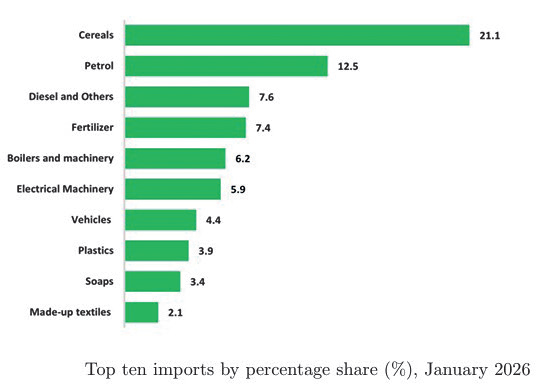
On the other hand, top 10 import commodities amounted to $291.4 million (about K510.2 billion) and included cereals at $82.6 million (about K144.6 billion), petrol at $48.7 million (about K85.2 billion) and diesel at $29.8 million (about K52 billion).
The January figures come at a time the annual trade deficit in 2025 widened by 15 percent to $2.67 billion (about K4.6 trillion) from $2.2 billion (about K3.8 trillion) the previous year driven by a surge in imports and a decline in exports.
In the year, total exports were recorded at $3.2 billion (about K5.6 trillion) against exports at $900 million (about K1.5 trillion), creating at $2.3 billion (about K4 trillion) trade gap.
Economists said the worsening trade deficit reflects the country’s over-reliance on few export commodities, persistent underproduction and weak participation in international markets.
University of Malawi economics lecturer Edward Leman, in an interview on Tuesday, said for decades, Malawi has relied on tobacco as its main source of export revenue, with limited and inconsistent efforts towards diversification.
He said: “Value addition has remained largely rhetorical, repeated year after year with little tangible progress.
“As a result, national competitiveness remains fragile and the country is steadily losing comparative advantage in traditional exports such as tea.”
Leman said compounding this challenge is the fact that domestic production increasingly fails to meet local demand, forcing higher levels of importation.”
In a separate interview, Mzuzu University economics lecturer Christopher Mbukwa said the widening trade deficit is both structural and transactional weaknesses in the economy.
He said: “The reason for the increased trade deficit is the drop in sales of tobacco, groundnuts and tea.
“The rise in this deficit can be attributed to transactions that were done in kwacha this year as opposed to the traditional dollar transactions over the years.”
Export Development Fund managing director Frederick Chanza said in an interview the core weakness is not merely weak export receipts, but the country’s chronic failure to produce at a scale demanded by the global market.
He said the economy will remain trapped “if we keep on exporting raw commodities and importing expensive finished products”.
Said Chanza: “If we are going to restructure our trade and narrow the deficit, we must build scale. That is why we are financing industrial parks, mining projects and high-value processing.”
Trade deficits continued to pile up despite Malawi implementing the National Export Strategy II, which sought to diversify exports, move away from reliance on raw exports and increase the value of locally manufactured goods.